IMPROVEMENTS AT CNCTECH’S FACTORY FOLLOWING THE IMPROVEMENT PROGRAM OF TOYOTA & THE MINISTRY OF INDUSTRY AND TRADE


 12-07-2023
 Back to news
In July 2023, Toyota Motor Vietnam and the Industry Agency – Ministry of Industry and Trade signed a Memorandum of Understanding on the Cooperation Project to support domestic enterprises in the automotive supporting industry, aiming to enhance capabilities and strengthen linkages between domestic supporting enterprises and automobile assemblers.
Toyota sent experts to the suppliers to identify existing problems and provide consulting and support. In particular, the 2 suppliers supported in the 2022 project, Kim Sen Industrial JSC and Cao Su 75 One Member Co., Ltd., accompanied Toyota in sharing the knowledge they had been trained in to extend support to this year’s suppliers, thereby contributing to the development of the supporting industry as well as Vietnam’s automotive industry.

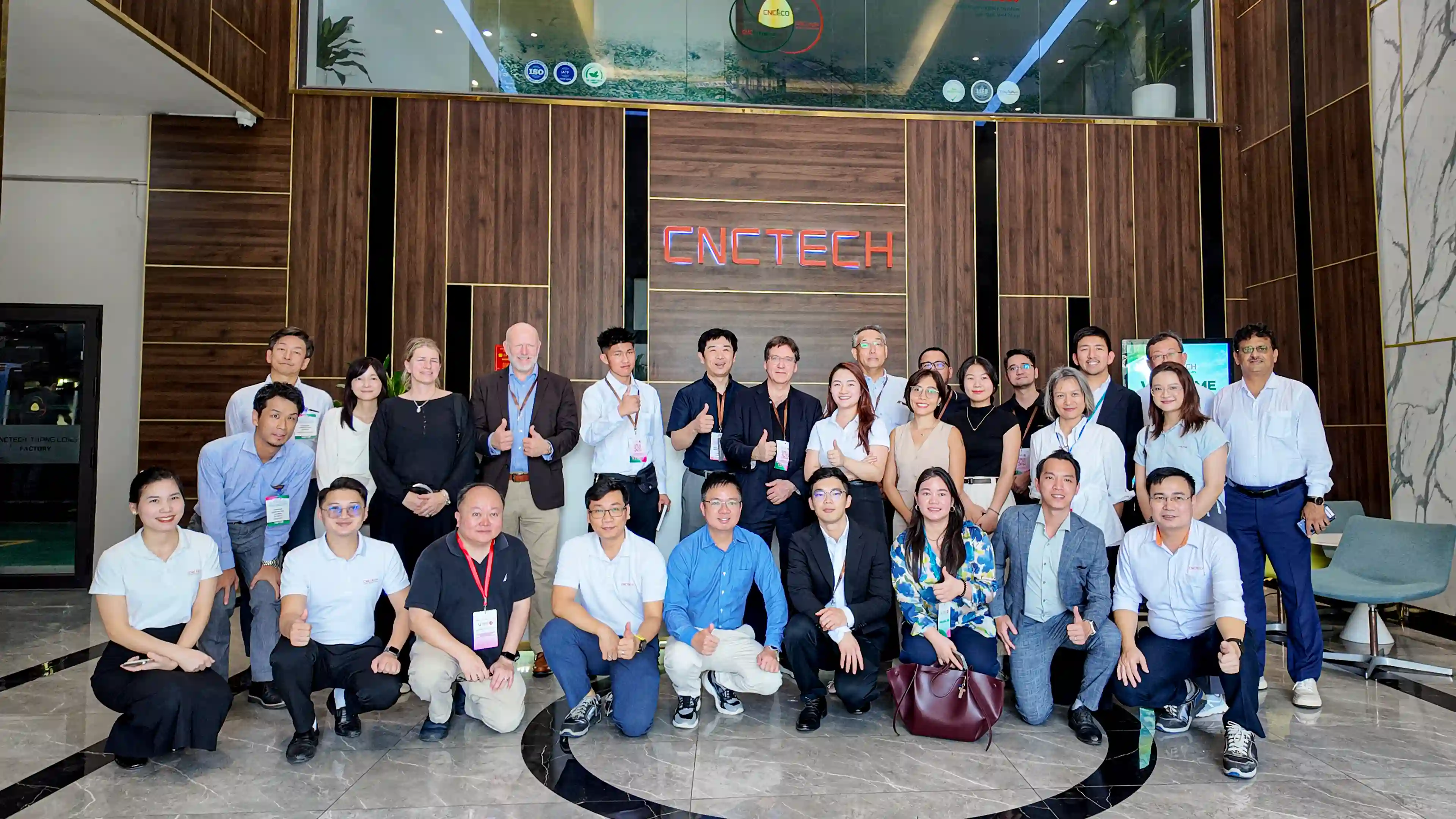
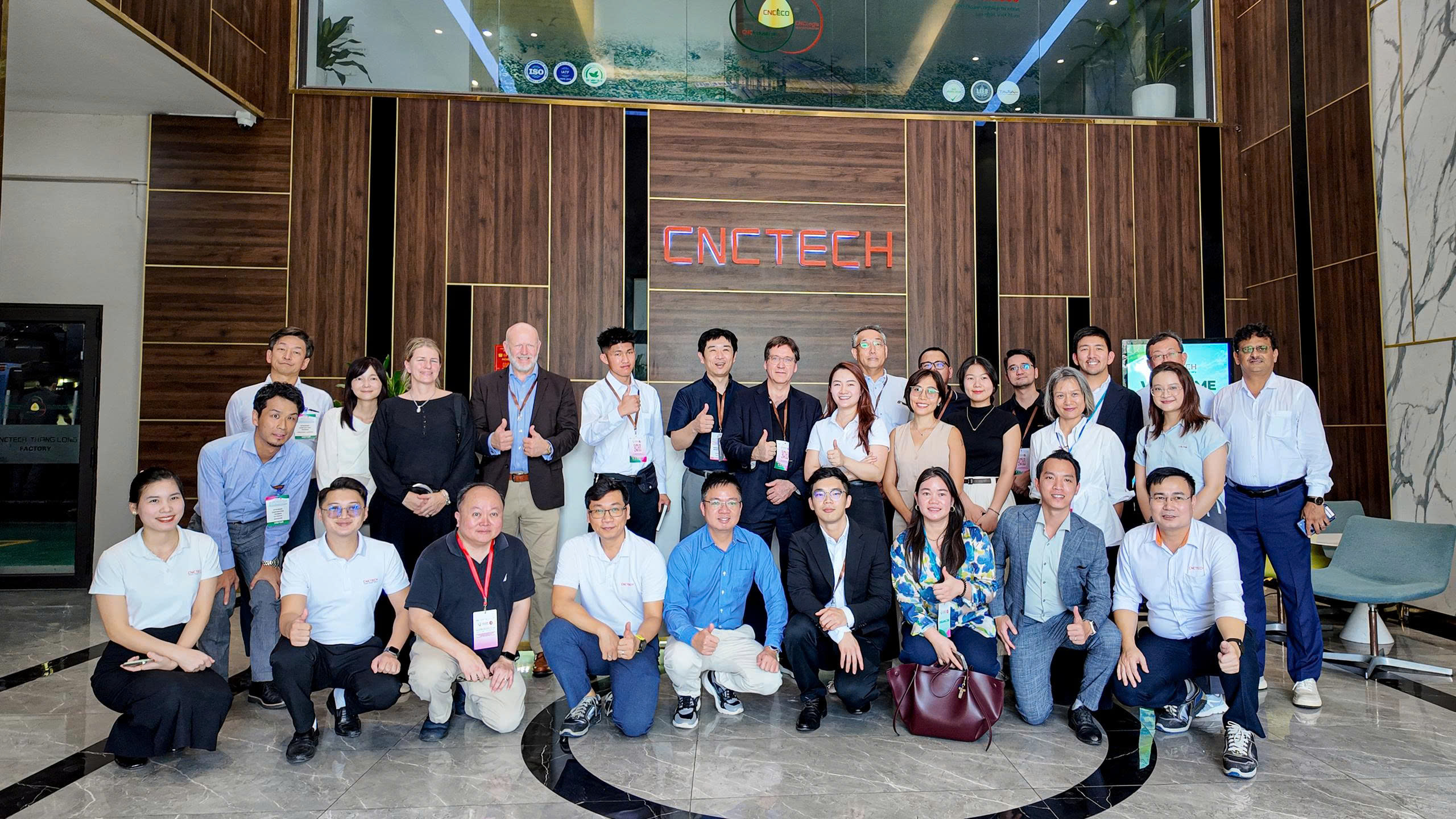
The CNCTech factory director guiding guests on a tour of the production workshop
After 2 rounds of evaluation and selection, CNCTech Thăng Long outperformed 200 applicant enterprises to be selected as one of 7 enterprises to receive support from Toyota Motor Vietnam.
After more than 6 months of implementation, the program recorded very positive results in 5S improvement activities (Sort – Set in Order – Shine – Standardize – Sustain), occupational safety and Kaizen (Toyota’s continuous improvement program) across many areas, such as reducing inventory and factory floor space, optimizing costs, increasing productivity and improving the working environment for workers… at all 7 suppliers, with several outstanding results.
We have applied typical Kaizen practices to production
1. 5S activities
5S is one of the key Kaizen programs, whose main purpose is to arrange and lay out the production floor scientifically and rationally, and to raise workers’ self-discipline and sense of responsibility toward the company. We apply Toyota’s 5 management tools (5 drivers) with 16 evaluation criteria, divide the site into 5S Zones, train 5S auditors, conduct ranking assessments, implement a reward policy, and ensure close leadership involvement in the program.
a. Rack organization
Set in Order is the activity of placing work tools, semi-finished products, raw materials, goods… in suitable locations so that they are easy to identify, easy to pick up and easy to return. The general principle of S2 is that every necessary item has its own designated location with clear identification markings. S2 is an activity that must be strictly followed.
At CNCTech, we have applied this and redesigned the dimensions of shelves/racks according to product type and JIGs, saving 4 m2 of factory floor space and reducing the number of storage racks.

Before and after 5S improvement at the CNCTech machining workshop
Not only applied in the production workshops, 5S Set in Order is also implemented very seriously in CNCTech’s offices.

Document arrangement before and after improvement at the CNCTech office
b. Creating a safe & friendly working environment
To ensure worker safety, easier movement and better visibility, CNCTech removed the large evaporative air cooler in the middle and instead rerouted the power lines and mounted fans up high

Before and after 5S improvement at the CNCTech machining workshop
2. Standardized work – WI
We clearly display the standardized work steps, including key points, in order to: Ensure Safety, Quality and Production schedule. The issues raised and addressed were: revising and updating all WIs, evaluating & revising based on members’ actual work, training on the new WIs, monitoring & checking WIs daily, and filming videos to compare the WIs of members on 2 shifts – Before the improvement, CNCTech still had outstanding issues: no key points and reasons for key points regarding S (Safety), Q (Quality), P (Productivity), and no operation times – After the improvement, quality is ensured & employee work performance is managed: parts are placed in the correct positions.

3. TPS Motion
TPS works by striving to eliminate waste in every aspect of production to achieve the leanest possible production model. CNCTech selected 4 of the 21 criteria to address difficult and strenuous operations at work by observing the CNC shop floor and filming videos for analysis to identify wasteful and difficult motions.
Before the improvement, foam rolls were stood upright one by one, making foam cutting very difficult as workers had to bend and twist their bodies. After the improvement, we designed a foam roll hanging rack and built a foam cutting mechanism
-> As a result, bending motions were completely eliminated, saving up to 200 minutes/month of cutting time.

b. Tool cart design
Instead of using the low, hard-to-move Tool carts of the past, which required employees to carry heavy loads, bend and reach, and consumed labor, we designed a Tool cart level with the machine surface and racks, with a push handle -> Saving 4 minutes/month.


4. Material flow – MFC
In the material flow, we review the overall product flow so that we can easily detect abnormalities in work steps, inventory, production lead time, logistics, etc. From there, we arrange a continuous production flow => No stoppages and reduced inventory 2. Production in a lean manner => Reduced lead time
In practice, we have applied this and changed the layout of the printing, deburring and QC rooms to make movement more rational and save more time and effort
a. Moving the deburring and QC room layout of F1 onto the line (One piece flow)
Placing Deburring, QC and packaging at the end of the CNC machine line, instead of concentrating them at 1 point with long travel times as before, has helped CNCTech save up to 120 km of travel/month, 154 m2 of factory floor space and 7 workers for these processes.

b. Arranging the production flow and moving the billet cutting machine from the 2nd floor to the 1st floor
Before the improvement, workers had to carry long, heavy aluminum bars from the raw material warehouse up to the 2nd floor, costing effort and time of about 3,840 minutes/month ~ 60 km/month. After the improvement, we moved the cutting machine from the 2nd floor down to the 1st floor, where employees cut the stock into small billets before transporting them to the machines. This reduces strenuous work, shortens operation time for workers, and saves up to 65 m2 of factory floor space.

In July 2023, Toyota Motor Vietnam and the Industry Agency – Ministry of Industry and Trade signed a Memorandum of Understanding on the Cooperation Project to support domestic enterprises in the automotive supporting industry, aiming to enhance capabilities and strengthen linkages between domestic supporting enterprises and automobile assemblers.
Toyota sent experts to the suppliers to identify existing problems and provide consulting and support. In particular, the 2 suppliers supported in the 2022 project, Kim Sen Industrial JSC and Cao Su 75 One Member Co., Ltd., accompanied Toyota in sharing the knowledge they had been trained in to extend support to this year’s suppliers, thereby contributing to the development of the supporting industry as well as Vietnam’s automotive industry.
The CNCTech factory director guiding guests on a tour of the production workshop
After 2 rounds of evaluation and selection, CNCTech Thăng Long outperformed 200 applicant enterprises to be selected as one of 7 enterprises to receive support from Toyota Motor Vietnam.
After more than 6 months of implementation, the program recorded very positive results in 5S improvement activities (Sort – Set in Order – Shine – Standardize – Sustain), occupational safety and Kaizen (Toyota’s continuous improvement program) across many areas, such as reducing inventory and factory floor space, optimizing costs, increasing productivity and improving the working environment for workers… at all 7 suppliers, with several outstanding results.
We have applied typical Kaizen practices to production
1. 5S activities
5S is one of the key Kaizen programs, whose main purpose is to arrange and lay out the production floor scientifically and rationally, and to raise workers’ self-discipline and sense of responsibility toward the company. We apply Toyota’s 5 management tools (5 drivers) with 16 evaluation criteria, divide the site into 5S Zones, train 5S auditors, conduct ranking assessments, implement a reward policy, and ensure close leadership involvement in the program.
a. Rack organization
Set in Order is the activity of placing work tools, semi-finished products, raw materials, goods… in suitable locations so that they are easy to identify, easy to pick up and easy to return. The general principle of S2 is that every necessary item has its own designated location with clear identification markings. S2 is an activity that must be strictly followed.
At CNCTech, we have applied this and redesigned the dimensions of shelves/racks according to product type and JIGs, saving 4 m2 of factory floor space and reducing the number of storage racks.
Before and after 5S improvement at the CNCTech machining workshop
Not only applied in the production workshops, 5S Set in Order is also implemented very seriously in CNCTech’s offices.
Document arrangement before and after improvement at the CNCTech office
b. Creating a safe & friendly working environment
To ensure worker safety, easier movement and better visibility, CNCTech removed the large evaporative air cooler in the middle and instead rerouted the power lines and mounted fans up high
Before and after 5S improvement at the CNCTech machining workshop
2. Standardized work – WI
We clearly display the standardized work steps, including key points, in order to: Ensure Safety, Quality and Production schedule. The issues raised and addressed were: revising and updating all WIs, evaluating & revising based on members’ actual work, training on the new WIs, monitoring & checking WIs daily, and filming videos to compare the WIs of members on 2 shifts – Before the improvement, CNCTech still had outstanding issues: no key points and reasons for key points regarding S (Safety), Q (Quality), P (Productivity), and no operation times – After the improvement, quality is ensured & employee work performance is managed: parts are placed in the correct positions.
3. TPS Motion
TPS works by striving to eliminate waste in every aspect of production to achieve the leanest possible production model. CNCTech selected 4 of the 21 criteria to address difficult and strenuous operations at work by observing the CNC shop floor and filming videos for analysis to identify wasteful and difficult motions.
Before the improvement, foam rolls were stood upright one by one, making foam cutting very difficult as workers had to bend and twist their bodies. After the improvement, we designed a foam roll hanging rack and built a foam cutting mechanism
-> As a result, bending motions were completely eliminated, saving up to 200 minutes/month of cutting time.
b. Tool cart design
Instead of using the low, hard-to-move Tool carts of the past, which required employees to carry heavy loads, bend and reach, and consumed labor, we designed a Tool cart level with the machine surface and racks, with a push handle -> Saving 4 minutes/month.
4. Material flow – MFC
In the material flow, we review the overall product flow so that we can easily detect abnormalities in work steps, inventory, production lead time, logistics, etc. From there, we arrange a continuous production flow => No stoppages and reduced inventory 2. Production in a lean manner => Reduced lead time
In practice, we have applied this and changed the layout of the printing, deburring and QC rooms to make movement more rational and save more time and effort
a. Moving the deburring and QC room layout of F1 onto the line (One piece flow)
Placing Deburring, QC and packaging at the end of the CNC machine line, instead of concentrating them at 1 point with long travel times as before, has helped CNCTech save up to 120 km of travel/month, 154 m2 of factory floor space and 7 workers for these processes.
b. Arranging the production flow and moving the billet cutting machine from the 2nd floor to the 1st floor
Before the improvement, workers had to carry long, heavy aluminum bars from the raw material warehouse up to the 2nd floor, costing effort and time of about 3,840 minutes/month ~ 60 km/month. After the improvement, we moved the cutting machine from the 2nd floor down to the 1st floor, where employees cut the stock into small billets before transporting them to the machines. This reduces strenuous work, shortens operation time for workers, and saves up to 65 m2 of factory floor space
c. Moving the printing room from the 1st floor to the 4th floor
This method reduces the travel distance of finished products after printing by 70 km/month and saves 195 m of factory floor space by moving the printing room from the 1st floor to the 4th floor next to the finished goods warehouse, instead of keeping them far apart as before

d. Changing the F2 machining production flow
A continuous production method from Machining -> Deburring -> Inspection -> Packaging on a single line, instead of the previous need to hold inventory and spend a lot of time moving between these processes due to separate work areas.

With the Mobile QC method in the plastic molding department, QC staff go directly to the machines to inspect and pack, instead of moving parts to a separate QC area for inspection as before, which caused in-process inventory and travel time.

These improvement activities have saved CNCTech a total of 578 m2 of factory floor space, 14 personnel, 6 days of semi-finished goods inventory and 242.2 km/month of travel distance.

This is an important program for developing and enhancing the production capacity/competitiveness of supporting industry enterprises in Vietnam, toward participation in the global value chain.
c. Moving the printing room from the 1st floor to the 4th floor
This method reduces the travel distance of finished products after printing by 70 km/month and saves 195 m of factory floor space by moving the printing room from the 1st floor to the 4th floor next to the finished goods warehouse, instead of keeping them far apart as before
d. Changing the F2 machining production flow
A continuous production method from Machining -> Deburring -> Inspection -> Packaging on a single line, instead of the previous need to hold inventory and spend a lot of time moving between these processes due to separate work areas.
With the Mobile QC method in the plastic molding department, QC staff go directly to the machines to inspect and pack, instead of moving parts to a separate QC area for inspection as before, which caused in-process inventory and travel time.
These improvement activities have saved CNCTech a total of 578 m2 of factory floor space, 14 personnel, 6 days of semi-finished goods inventory and 242.2 km/month of travel distance.
This is an important program for developing and enhancing the production capacity/competitiveness of supporting industry enterprises in Vietnam, toward participation in the global value chain.