DR. NGUYỄN TRUNG KIÊN, VICE CHAIRMAN AND CEO OF CNCTECH GROUP: FOR INNOVATION TO HAVE SUBSTANCE, IT MUST BE COMMERCIALIZABLE


 07-10-2026
 Back to news
According to a CNCTech representative, innovation must solve a specific problem and be commercializable. To go from a prototype to mass production, a machinery line is not enough; three foundations that businesses already have are needed: suppliers, distribution channels and international standards.
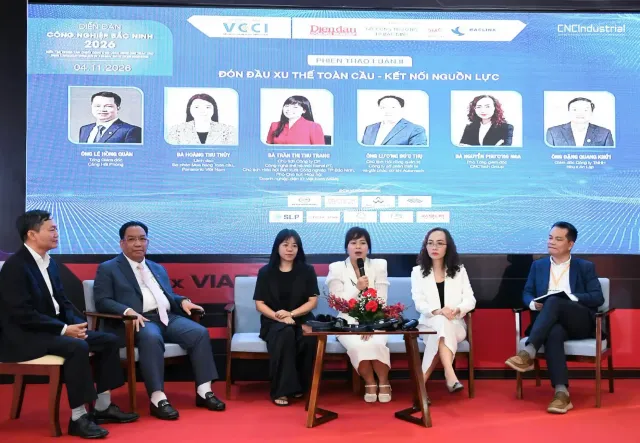
Developing innovation is a policy priority of the Government. At the National Future Forum on Science, Technology, Innovation and Digital Transformation 2026, the "three-party" model was mentioned many times by Mr. Nguyễn Mai Dương – Director of the Department of Innovation under the Ministry of Science and Technology (SATI) – and Mr. Bùi Quang Minh – Director of the National Technology Innovation Fund under the Ministry of Science and Technology (NATIF) – in their remarks.
The moderator posed two questions. Where does the major gap between a technology, a prototype and industrial-scale production currently lie? And how should Vietnam organize its pilot production capability, technical data, quality standards, automation and supplier network to shorten the journey from prototype to mass production and the global value chain?

Dr. Nguyễn Trung Kiên, Vice Chairman and CEO of CNCTech Group, offered his assessment. CNCTech has three business segments: supporting industry manufacturing and OEM for foreign companies, industrial park infrastructure development and logistics. In this answer, he focused on the manufacturing services segment. And his answer began with two words: "real substance."
Innovation must be commercializable
Dr. Nguyễn Trung Kiên started from the Government's policy of developing innovation and argued that it needs to go into real substance. He said: "In my view, real substance here means solving a specific problem and, above all, being commercializable."
In the three-party model, the role of business that is often mentioned is placing orders, giving commissioned tasks to universities and research institutes for development. But in his view, not every idea starts that way. "For innovation activities, the work may not come from an order by a business but from an idea that has already been developed," the Doctor said.
It is precisely here that he believes the role of business is very important. The State has many policies that can support innovative ideas, research and development, and the creation of prototypes, or even getting to the mass production stage. The next leg belongs to businesses. Dr. Nguyễn Trung Kiên emphasized: "The next important stage is the question of how to mass-produce and how to go to market, and that is the role of businesses."
Three foundations that businesses already have
According to the Doctor, that cannot rely solely on production infrastructure, that is, the machinery lines a business has invested in, laboratories, or the fabrication, testing and support of startup ideas.
First, he affirmed the importance of suppliers. "We already have relationships with suppliers, and know how to buy at low prices," he shared. "First of all, we have to be able to talk to them."

The second foundation is distribution and commercialization. A business in the same field already has sales channels and a customer base. If the business is willing to help, that advantage will be put to very good use. "Who to sell to and how to sell, that is the role of the business," Dr. Nguyễn Trung Kiên said.
The third issue is standardization and international standards. He explained: "We may have a good idea, but if we want to sell to a corporation or a large company, and we can think about globalization, we have to know what standards we need to meet." In his view, businesses already working in the field, like CNCTech, understand these standards and can steer innovative ideas into practice.
"As a Vietnamese business, we are very ready to support innovative ideas," the Doctor affirmed.
An invitation to "come straight to CNCTech" and an export KPI
In the next part of his remarks, Dr. Nguyễn Trung Kiên made a proposal from CNCTech's position. Among the innovative ideas, the Department of Innovation could select those that fit CNCTech's capabilities so that the company can accompany and support them. He clearly defined the scope of support: "We support from pilot prototyping through commercialization, then connecting the supply chain and commercializing the product."
Here, the Doctor also invited the Department to visit the business directly, even to come straight to CNCTech. This approach is both to assess how a product goes from idea to commercialization and to provide close guidance when businesses encounter difficulties and obstacles in the commercialization process.
The proposal received an immediate response. "I ask the officials of the Department of Innovation to arrange a schedule, and we will work with CNCTech on this topic," the regulatory agency's representative said.

Dr. Nguyễn Trung Kiên's answer followed a clear thread: innovation must solve a specific problem and be commercializable. State policy can support an idea in reaching a prototype. Mass production and going to market are the role of businesses.
The most noteworthy point is that what businesses bring is not only machinery lines. It is also relationships with suppliers, existing sales channels and customer bases, and an understanding of the standards that must be met when selling to a corporation or a large company.
A working plan between the Department of Innovation and CNCTech took shape right at the forum. When regulators, idea owners and manufacturers accompany one another from pilot prototyping, the road from prototype to market has a chance to get shorter. The hoped-for fruit of that cooperation is Vietnamese innovative ideas entering practice and stepping into the global value chain.
Source: GenK – Information site for technology enthusiasts – Dr. Nguyễn Trung Kiên, Vice Chairman and CEO of CNCTech Group: For innovation to have substance, it must be commercializable.